

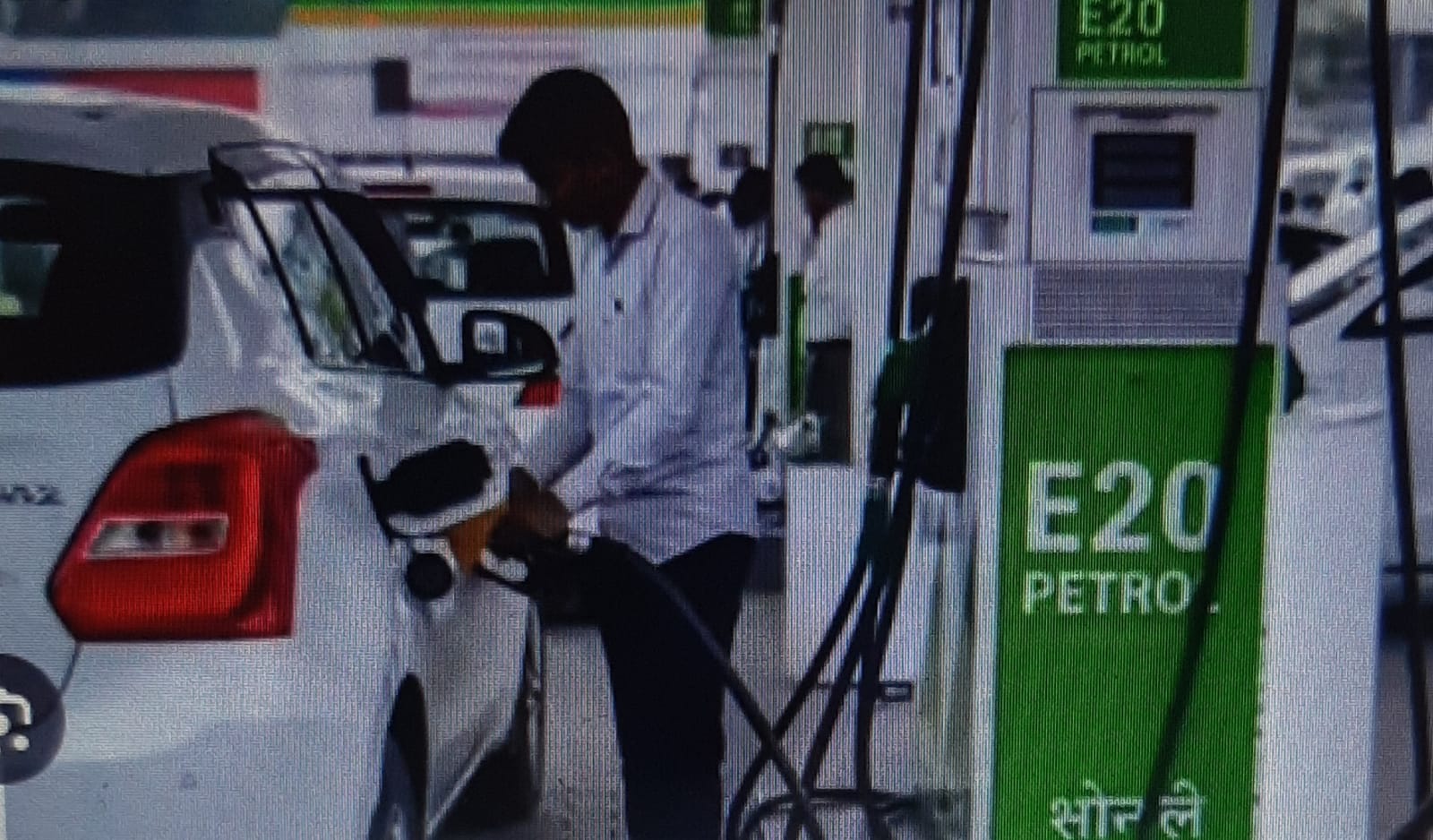
E20 is not a nightmare, and it is not a triumph. It is a policy that succeeded in its original aim, then outgrew it. The sugar exit from the tender is the moment to ask whether the programme still serves its stated purposes, or merely the capacity built in its name. A mandate designed for surplus should not become a claim on the nation’s plate, writes former IAS officer V S Pandey.
The government’s latest ethanol tender quietly rewrites the founding logic of India’s blending programme. For years, the case for ethanol blending rested on a neat triangle: cut crude imports, clear cane arrears, rescue sugar mills. Oil marketing companies have now been told that sugar diversion for ethanol must be reduced to zero for supply year 2026-27, so no offers were sought from cane juice, sugar, syrup or B-heavy molasses. The companies are seeking about 11 billion litres from other feedstocks, namely C-heavy molasses, damaged food grains, surplus FCI rice, maize and others.
The trigger is sugar. The average retail price stood at Rs 63.05 a kg this August, 29 per cent above the level a month earlier. The industry body ISMA insists there is no shortage and blames speculation, festive demand and lower-than-expected output, noting that grain-based ethanol already accounts for an estimated 75 per cent of supply. The government nonetheless opened a duty-free raw sugar import window.
The founding argument has already been hollowed out
It would be wrong to say the sugar argument vanished overnight. It eroded for two years. Sugar-based ethanol’s contribution fell from 73 per cent to just 28 per cent as grain-based supply rose. In the current supply year, grain feedstocks supplied 71.4 per cent of receipts by September, with maize alone contributing 413 crore litres. The mills’ exposure to ethanol, in other words, was shrinking long before this tender.
The government’s defence is not trivial. A food ministry official says arrears owed to sugarcane farmers are now at their lowest level ever and that the programme has saved over Rs 1.90 lakh crore in foreign exchange since 2014-15. These are official claims. Independent analysts have pushed back on scale: one analysis noted that crude savings over the decade to 2024 were about 18 million tonnes, only 0.8 per cent of total oil imported. Both can be true: the programme helped cane economics, yet its macro impact on import dependence is very modest.
The burden shifts to food and feed
As was feared , zero sugar diversion means the same 20 per cent target must be met from grain. The pressure points are already visible. India became a net maize importer in 2024 for the first time in decades, and domestic prices rose from about Rs 15,000 to Rs 25,000 a tonne in four years, with roughly a third of production now contracted for ethanol. Parliament data puts production near 43.4 million tonnes, with about 17 million tonnes going to ethanol, and egg prices have reportedly jumped by up to 40 per cent. Poultry consumes around 60 per cent of India’s maize, so this is a household-food issue, not merely an industry quarrel.
The forecasts point the wrong way. The grain ethanol manufacturers’ association expects maize demand for ethanol to rise 40–50 per cent next year if rice supplies stay unchanged, while USDA expects India’s maize output to fall 10 per cent in 2026-27. That collision of rising demand and falling supply is precisely when food-versus-fuel debates turn from academic to political.
The government appears alert to this, since the tender cuts the incentive for corn-based ethanol from Rs 5.79 to Rs 2.79 a litre, lowering the price to Rs 68.86. That is a rational attempt to cool maize demand, but it also signals that policymakers know the grain pipeline cannot be stretched indefinitely.
There is a counterpoint worth stating fairly: maize farmers are not uniformly winners. Agricultural university forecasters warn that growers in several regions struggle to realise even the MSP of Rs 2,410 a quintal. The impact on farmers is uneven, not uniformly positive or negative.
The capacity paradox
Here lies the programme’s deeper design problem. Capacity has reportedly reached nearly 20 billion litres, against roughly 11 billion litres needed for E20. A distillery base nearly twice the mandated demand creates a permanent lobby for higher blends, E27 and beyond, whatever the food-security cost. When capacity is built ahead of demand, policy tends to bend to protect the investment.
Is it justified?
The honest answer is: partly, and not on the old grounds. Diverting grain to fuel can be defended as a use of genuinely surplus stocks, such as FCI rice and damaged grain. It is much harder to defend when it begins to move the prices of eggs, chicken and feed, and when maize imports creep in to fill the gap. The think-tank ICRIER has argued that India may need to consider a lower blending rate when crops such as sugar and maize are in short supply.
That points to the reform worth debating: a flexible blending corridor, say 10 to 20 per cent, tied to stock levels of sugar, rice and maize, falling petrol vehicle averages, rather than a fixed mandate that the kitchen , car owners and the poultry farm must underwrite. Add transparent publication of net crude savings after accounting for feedstock imports, an independent mileage audit, and water-use disclosure, since experts have urged lifecycle water accounting and food-security safeguards before moving beyond E20.
E20 is not a nightmare, and it is not a triumph. It is a policy that succeeded in its original aim, then outgrew it. The sugar exit from the tender is the moment to ask whether the programme still serves its stated purposes, or merely the capacity built in its name. A mandate designed for surplus should not become a claim on the nation’s plate.
(Vijay Shankar Pandey is former Secretary Government of India)