


India’s solar story is genuinely impressive. But a green energy transition built on a Chinese supply chain is neither secure nor truly sovereign. For a nation that aspires to be a global leader in clean energy — and that has pledged to reduce its import dependence as a matter of strategic doctrine — the urgency of fixing this cannot be overstated, writes former IAS officer V.S.Pandey
As India races toward its 500 GW renewable target, a dangerous dependency on Beijing threatens to undermine the nation’s green ambitions
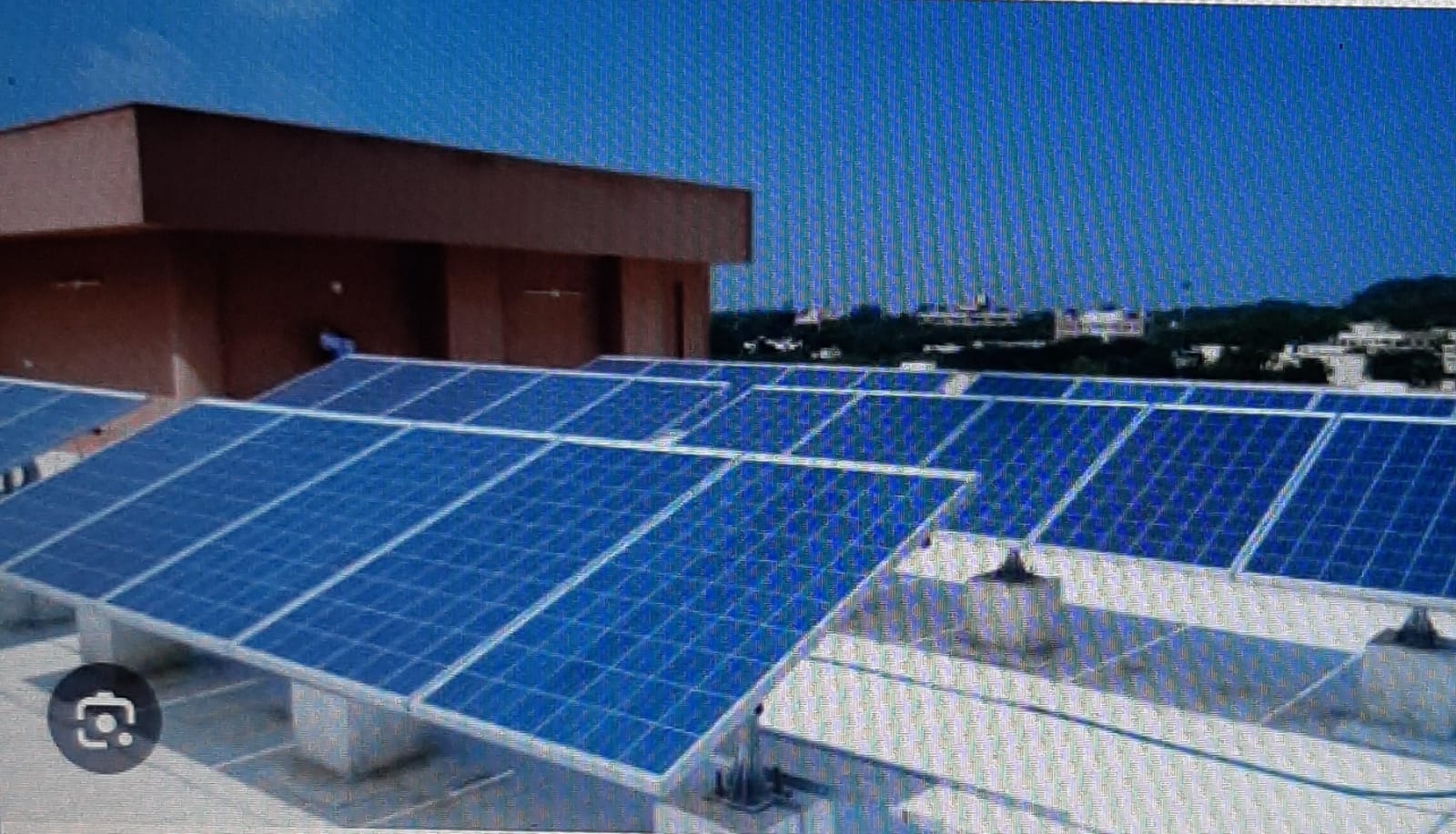
India loves to celebrate its solar story — and rightly so. With over 170 GW of solar capacity installed and a target of 500 GW of renewable energy by 2030, the country has positioned itself as one of the world’s most ambitious clean energy nations. But behind the gleaming rows of solar panels that now dot rooftops and vast tracts of Rajasthan’s desert land lies an uncomfortable truth: the very panels powering India’s green revolution are, at their core, made in China.
From the polysilicon that forms the heart of every solar cell to the precision-cut wafers that convert sunlight into electricity, India is almost entirely dependent on Chinese raw materials and components. China controls over 93 percent of global polysilicon production and 97 percent of wafer manufacturing. India’s own polysilicon capacity stands at a meagre 3.3 GW — less than 5 percent of its module manufacturing capacity. Every solar panel assembled in an Indian factory is, in essence, a Chinese product with an Indian label.
This is not merely an economic vulnerability. It is a strategic one. In a world of heightening geopolitical tensions, India’s dependence on a nation with whom it shares a contested border for the most critical inputs of its energy transition is an exposure no policymaker should be comfortable with.
Policy Story of Good Intentions and Broken Execution: The story of how India arrived at this point is, at its heart, a story of well-intentioned policies hobbled by inconsistency, short-sightedness, and bureaucratic timidity.
The government’s flagship Production Linked Incentive (PLI) scheme for solar manufacturing, launched in two tranches in 2021 and 2023 with a total outlay of ₹24,000 crore, was designed specifically to build a vertically integrated solar supply chain — from polysilicon all the way to finished modules. The ambition was sound. The execution was not.
Frequent and unpredictable changes to the Approved List of Models and Manufacturers (ALMM) rules repeatedly disrupted the investment planning of companies that had committed billions to upstream manufacturing. A factory for polysilicon or wafers requires a decade-long investment horizon — investors need predictable policy, not shifting goalposts. Each policy reversal sent a chilling signal to the private capital that the government desperately needed to attract.
The safeguard duties imposed on solar imports — meant to protect domestic manufacturers — were challenged at the World Trade Organization and implemented inconsistently, offering manufacturers little of the protection they were promised. Meanwhile, cheap Chinese panels continued to flood the Indian market, making it nearly impossible for domestic upstream producers to compete on price even when they managed to set up shop.
Perhaps most critically, the government focused its incentives almost entirely on the downstream end of the supply chain — modules and, eventually, cells. The upstream segments of polysilicon and wafers, which are far more capital-intensive, energy-intensive, and technically complex, were treated as an afterthought. India today has 172 GW of module manufacturing capacity and virtually zero commercial wafer or polysilicon production to feed it. The pyramid was built upside down.
The Hard Truths Nobody Wants to Address: Building a polysilicon plant is not like building a textile mill. A world-class facility costs upward of a billion dollars, consumes staggering quantities of electricity around the clock, handles hazardous chemicals, and requires an ecosystem of highly skilled engineers and scientists that India has not yet developed at scale. China built its dominance over two decades of patient, state-backed investment, ruthless economies of scale, and access to some of the cheapest electricity on earth.
India’s industrial electricity tariffs, by contrast, remain significantly higher than China’s. Since power accounts for nearly 40–50 percent of polysilicon production costs, this single factor puts Indian producers at a structural disadvantage before a single kilogram of silicon is refined.
A Roadmap to Self-Sufficiency: What Must Be Done: The path to genuine solar self-sufficiency is not impossible — but it demands a level of strategic commitment and policy discipline that India has not yet demonstrated in this sector.
First, a dedicated PLI for polysilicon must be operationalised immediately. The Ministry of New and Renewable Energy has acknowledged that the existing ALMM framework does not work for polysilicon and has been in discussion with the Finance Ministry for a separate scheme. These discussions must end in decisive action. The incentive must be generous enough — and stable enough — to attract the ₹8,000–10,000 crore investments that a single world-scale polysilicon plant requires.
Second, cheap and guaranteed power must be provided to upstream solar manufacturers. The government should designate special energy zones for polysilicon and wafer production, where manufacturers are supplied power — ideally from dedicated renewable sources — at rates competitive with Chinese industrial tariffs. Without this, no incentive scheme will be enough.
Third, the ALMM framework must be stabilised and its timelines enforced. The mandate requiring domestically manufactured cells for government projects from June 2026, and wafers by 2028, must be upheld without further extensions. Credible enforcement is the only signal that will move private capital.
Fourth, India must invest aggressively in technology partnerships. Since no Indian company possesses proprietary polysilicon process technology, the government must facilitate joint ventures and technology licensing agreements with leading global producers in Europe, the United States, and South Korea. The recently improving ties with these nations should be leveraged for technology access in clean energy manufacturing.
Fifth, a national solar manufacturing mission — akin to the semiconductor mission — must be announced. India’s ₹76,000 crore semiconductor mission showed that when the government commits at scale, industry follows. Solar upstream manufacturing deserves the same treatment, with a dedicated mission office, single-window clearances, and a long-term offtake guarantee framework.
The Clock is Ticking: Analysts project that by 2030, India could — with the right policy execution — reach a point where it only needs to import polysilicon, with all other components manufactured domestically. That is a realistic near-term milestone. Full self-sufficiency, including domestic polysilicon production at scale, is a 2032–2035 ambition if work begins in earnest today.
India’s solar story is genuinely impressive. But a green energy transition built on a Chinese supply chain is neither secure nor truly sovereign. For a nation that aspires to be a global leader in clean energy — and that has pledged to reduce its import dependence as a matter of strategic doctrine — the urgency of fixing this cannot be overstated.
The sun is shining on India’s solar ambitions. It is time the country learned to manufacture the tools to capture it.
(Vijay Shankar Pandey is former Secretary Government of India)
India’s solar story is genuinely impressive. But a green energy transition built on a Chinese supply chain is neither secure nor truly sovereign. For a nation that aspires to be a global leader in clean energy — and that has pledged to reduce its import dependence as a matter of strategic doctrine — the urgency of fixing this cannot be overstated, writes former IAS officer V.S.Pandey
As India races toward its 500 GW renewable target, a dangerous dependency on Beijing threatens to undermine the nation’s green ambitions
India loves to celebrate its solar story — and rightly so. With over 170 GW of solar capacity installed and a target of 500 GW of renewable energy by 2030, the country has positioned itself as one of the world’s most ambitious clean energy nations. But behind the gleaming rows of solar panels that now dot rooftops and vast tracts of Rajasthan’s desert land lies an uncomfortable truth: the very panels powering India’s green revolution are, at their core, made in China.
From the polysilicon that forms the heart of every solar cell to the precision-cut wafers that convert sunlight into electricity, India is almost entirely dependent on Chinese raw materials and components. China controls over 93 percent of global polysilicon production and 97 percent of wafer manufacturing. India’s own polysilicon capacity stands at a meagre 3.3 GW — less than 5 percent of its module manufacturing capacity. Every solar panel assembled in an Indian factory is, in essence, a Chinese product with an Indian label.
This is not merely an economic vulnerability. It is a strategic one. In a world of heightening geopolitical tensions, India’s dependence on a nation with whom it shares a contested border for the most critical inputs of its energy transition is an exposure no policymaker should be comfortable with.
Policy Story of Good Intentions and Broken Execution: The story of how India arrived at this point is, at its heart, a story of well-intentioned policies hobbled by inconsistency, short-sightedness, and bureaucratic timidity.
The government’s flagship Production Linked Incentive (PLI) scheme for solar manufacturing, launched in two tranches in 2021 and 2023 with a total outlay of ₹24,000 crore, was designed specifically to build a vertically integrated solar supply chain — from polysilicon all the way to finished modules. The ambition was sound. The execution was not.
Frequent and unpredictable changes to the Approved List of Models and Manufacturers (ALMM) rules repeatedly disrupted the investment planning of companies that had committed billions to upstream manufacturing. A factory for polysilicon or wafers requires a decade-long investment horizon — investors need predictable policy, not shifting goalposts. Each policy reversal sent a chilling signal to the private capital that the government desperately needed to attract.
The safeguard duties imposed on solar imports — meant to protect domestic manufacturers — were challenged at the World Trade Organization and implemented inconsistently, offering manufacturers little of the protection they were promised. Meanwhile, cheap Chinese panels continued to flood the Indian market, making it nearly impossible for domestic upstream producers to compete on price even when they managed to set up shop.
Perhaps most critically, the government focused its incentives almost entirely on the downstream end of the supply chain — modules and, eventually, cells. The upstream segments of polysilicon and wafers, which are far more capital-intensive, energy-intensive, and technically complex, were treated as an afterthought. India today has 172 GW of module manufacturing capacity and virtually zero commercial wafer or polysilicon production to feed it. The pyramid was built upside down.
The Hard Truths Nobody Wants to Address: Building a polysilicon plant is not like building a textile mill. A world-class facility costs upward of a billion dollars, consumes staggering quantities of electricity around the clock, handles hazardous chemicals, and requires an ecosystem of highly skilled engineers and scientists that India has not yet developed at scale. China built its dominance over two decades of patient, state-backed investment, ruthless economies of scale, and access to some of the cheapest electricity on earth.
India’s industrial electricity tariffs, by contrast, remain significantly higher than China’s. Since power accounts for nearly 40–50 percent of polysilicon production costs, this single factor puts Indian producers at a structural disadvantage before a single kilogram of silicon is refined.
A Roadmap to Self-Sufficiency: What Must Be Done: The path to genuine solar self-sufficiency is not impossible — but it demands a level of strategic commitment and policy discipline that India has not yet demonstrated in this sector.
First, a dedicated PLI for polysilicon must be operationalised immediately. The Ministry of New and Renewable Energy has acknowledged that the existing ALMM framework does not work for polysilicon and has been in discussion with the Finance Ministry for a separate scheme. These discussions must end in decisive action. The incentive must be generous enough — and stable enough — to attract the ₹8,000–10,000 crore investments that a single world-scale polysilicon plant requires.
Second, cheap and guaranteed power must be provided to upstream solar manufacturers. The government should designate special energy zones for polysilicon and wafer production, where manufacturers are supplied power — ideally from dedicated renewable sources — at rates competitive with Chinese industrial tariffs. Without this, no incentive scheme will be enough.
Third, the ALMM framework must be stabilised and its timelines enforced. The mandate requiring domestically manufactured cells for government projects from June 2026, and wafers by 2028, must be upheld without further extensions. Credible enforcement is the only signal that will move private capital.
Fourth, India must invest aggressively in technology partnerships. Since no Indian company possesses proprietary polysilicon process technology, the government must facilitate joint ventures and technology licensing agreements with leading global producers in Europe, the United States, and South Korea. The recently improving ties with these nations should be leveraged for technology access in clean energy manufacturing.
Fifth, a national solar manufacturing mission — akin to the semiconductor mission — must be announced. India’s ₹76,000 crore semiconductor mission showed that when the government commits at scale, industry follows. Solar upstream manufacturing deserves the same treatment, with a dedicated mission office, single-window clearances, and a long-term offtake guarantee framework.
The Clock is Ticking: Analysts project that by 2030, India could — with the right policy execution — reach a point where it only needs to import polysilicon, with all other components manufactured domestically. That is a realistic near-term milestone. Full self-sufficiency, including domestic polysilicon production at scale, is a 2032–2035 ambition if work begins in earnest today.
India’s solar story is genuinely impressive. But a green energy transition built on a Chinese supply chain is neither secure nor truly sovereign. For a nation that aspires to be a global leader in clean energy — and that has pledged to reduce its import dependence as a matter of strategic doctrine — the urgency of fixing this cannot be overstated.
The sun is shining on India’s solar ambitions. It is time the country learned to manufacture the tools to capture it.
(Vijay Shankar Pandey is former Secretary Government of India)