

India’s agricultural paradox reflects a deeper structural challenge in the economy. When nearly half the workforce generates only a small share of national income, the result is low productivity and widespread income disparities. The long-term solution lies not merely in increasing agricultural output but in transforming the broader economic structure, writes former IAS officer V.S.Pandey
India is often described as an agrarian economy. Vast fields of wheat, rice, sugarcane and pulses stretch across the country, and agriculture continues to occupy a central place in the nation’s social and political life. Yet a striking paradox lies at the heart of the Indian economy: nearly half of India’s workforce depends on agriculture, but the sector contributes only a small fraction to the country’s total economic output.
This imbalance between employment and income is one of the most important structural challenges facing India today. Understanding it is essential for framing policies that can improve rural incomes and accelerate overall economic growth.
The basic imbalance: Recent economic data shows that around 42–45 percent of India’s workforce is engaged in agriculture, while the sector contributes only about 15–16 percent of the country’s Gross Domestic Product (GDP). In other words, almost half of the working population generates barely one-sixth of national income.
This disparity reveals a fundamental truth about India’s economic structure: the productivity of labour in agriculture is far lower than in other sectors such as manufacturing or services. A worker employed in a factory or in the information technology sector typically produces several times more economic value than a worker engaged in farming.
Such an imbalance is not unique to India during the early stages of development. Economic history shows that many countries initially had large agricultural workforces. However, as economies modernise, labour gradually moves from farms to industries and services where productivity and incomes are higher. This process is known in economics as structural transformation, a concept widely studied in the field of Development Economics.
Countries such as United Kingdom during the Industrial Revolution and later Japan and South Korea underwent this transition successfully. In these nations, the share of the workforce engaged in agriculture gradually fell to below 10 percent as manufacturing and services expanded.
India’s experience, however, has been different.
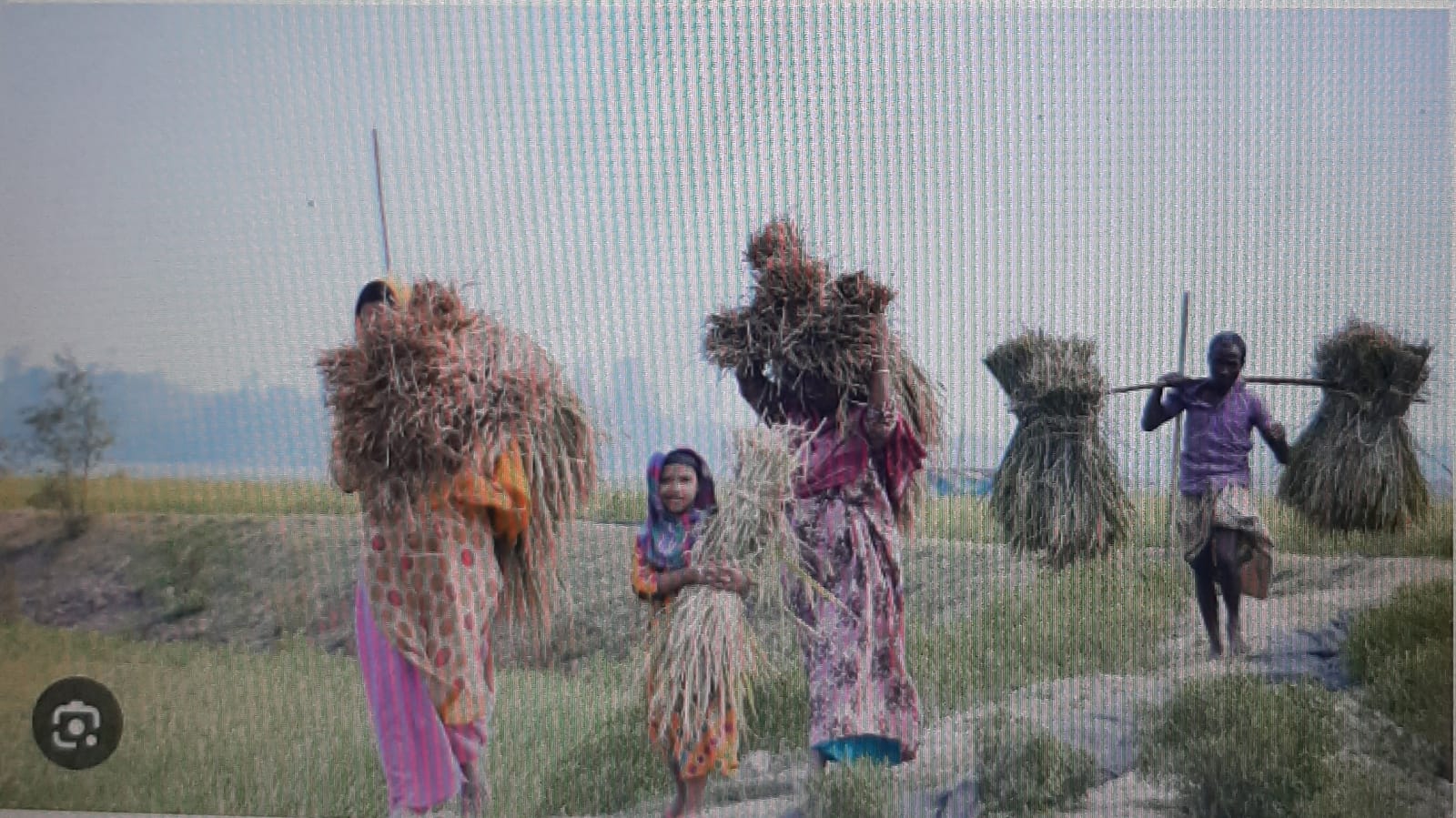
The problem of disguised unemployment: One major reason behind the paradox is the phenomenon known as disguised unemployment. Disguised unemployment occurs when more people are employed in a task than are actually required to produce the output. In rural India, this is a common reality. A small family farm may need only two or three workers to cultivate the land effectively, but six or seven members of the household may be working on it. The additional workers do not significantly increase production.
If some of these workers were to leave agriculture, total farm output would remain largely unchanged. However, because many people share the same limited income from the land, the earnings per worker become very low.
This hidden surplus labour is one of the main reasons why agricultural incomes remain modest despite the country producing large quantities of food grains.
Small and fragmented landholdings: Another structural issue is the extremely small size of landholdings in India. Over decades, repeated division of land among family members has resulted in fragmented plots. Today, the average operational holding in India is just a little over one hectare.
Small farms face several disadvantages. Upgradation of agricultural practices becomes difficult, irrigation investments become expensive, and farmers often lack the financial capacity to adopt modern technology. As a result, productivity remains relatively low.
Low value addition in agriculture: Agriculture also tends to generate lower economic value compared with industry and services. Most farmers sell raw commodities such as wheat, rice, sugarcane, vegetables or milk. The prices of these commodities are often volatile and relatively low compared to the value created in other sectors.
For example, the value generated by a software engineer developing a digital product or by a manufacturing worker producing high-tech machinery is far greater than that generated by producing raw agricultural commodities.
This explains why India’s rapidly expanding service sector contributes a much larger share to GDP even though it employs fewer people compared to agriculture.
Limited industrial absorption: The natural pathway for reducing pressure on agriculture is the expansion of manufacturing. Factories and industrial enterprises create large numbers of jobs and absorb surplus labour from rural areas.
Countries like China demonstrated this transformation on a massive scale after economic reforms initiated by Deng Xiaoping in the late 1970s. Over the following decades, hundreds of millions of Chinese workers moved from farms to factories and urban industries.
India’s manufacturing sector, however, has not grown rapidly enough to absorb a comparable share of rural labour. As a result, millions of people continue to depend on agriculture even when it cannot provide adequate income.
Agriculture as a social safety net: Agriculture in India also performs a social function beyond its economic role. For many rural families, farming serves as a safety net. Even when agricultural earnings are low, the land provides basic sustenance and a sense of security.
Urban migration involves risks such as uncertain employment, housing difficulties and social dislocation. Consequently, many families prefer to remain in villages and continue farming despite low returns.
This social dimension reinforces the persistence of a large agricultural workforce.
The consequences of the paradox: The imbalance between labour and output in agriculture has several important consequences.
First, it contributes to persistent rural poverty. When too many workers depend on a sector with limited income generation, individual earnings remain low.
Second, it widens income inequality between rural and urban populations. Workers in modern sectors often earn significantly higher wages than those engaged in agriculture.
Third, it leads to underemployment, where people are technically employed but do not work at their full productive capacity.
The path forward: Resolving this paradox requires a multi-pronged strategy.
Agriculture itself must become more productive through improved irrigation, better seeds, mechanisation and diversification into high-value crops such as fruits, vegetables and dairy products. Expanding food processing industries can also increase value addition to farm produce.
At the same time, the country must accelerate the growth of labour-intensive manufacturing sectors that can create large numbers of jobs. This would enable workers currently trapped in low-productivity agriculture to move into more productive occupations.
Finally, rural development policies should encourage non-farm employment through small industries, logistics networks and agro-processing enterprises.
Conclusion :India’s agricultural paradox reflects a deeper structural challenge in the economy. When nearly half the workforce generates only a small share of national income, the result is low productivity and widespread income disparities. The long-term solution lies not merely in increasing agricultural output but in transforming the broader economic structure—modernising farming while simultaneously creating new opportunities outside agriculture. Only then can millions of rural workers move towards more productive livelihoods and contribute more effectively to their own and nation’s prosperity.
(Vijay Shankar Pandey is former Secretary Government of India)