

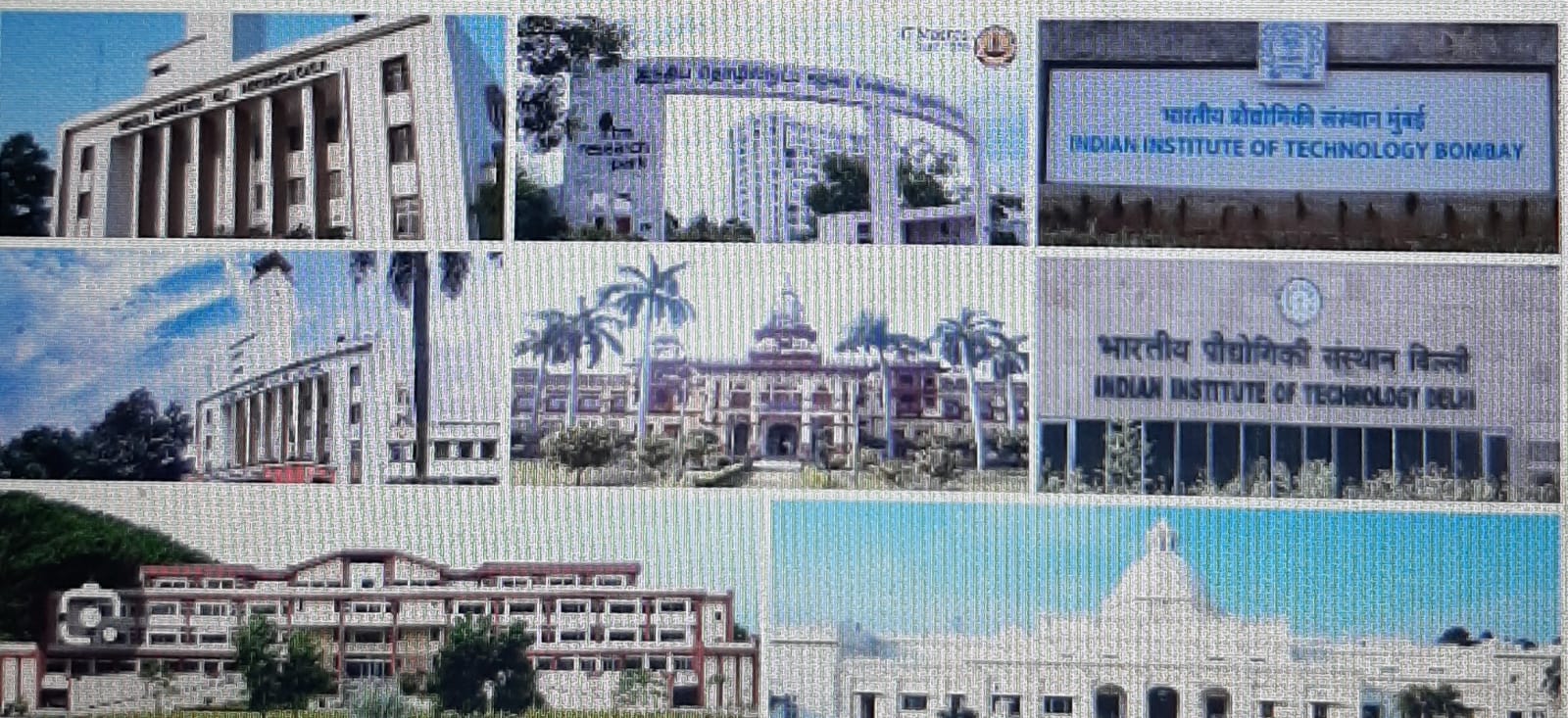
The IITs were conceived, in Nehru’s own words, as instruments of India’s industrial and scientific self-reliance. Six decades on, that founding purpose deserves an honest re-examination — not to diminish an institution that has genuinely raised India’s global profile, but to ensure that the next sixty years serve the country that has been paying the bill all along, writes former IAS officer V.S.Pandey
Why the country’s most celebrated engineering brand has yet to deliver where India needs it most. Every January, thousands of teenagers across India lock themselves into coaching-centre routines that would break most adults, chasing higher place on a rank list. The Indian Institutes of Technology remain the country’s most sought-after educational destination, a badge that promises transformation — of a family’s fortunes, of a young person’s future, and, ostensibly, of the nation’s technological standing. Six decades after the first IIT opened its gates in Kharagpur, it’s worth asking a plain, uncomfortable question: has the country actually got what it paid for?
The numbers suggest a troubling answer. Research published by the National Bureau of Economic Research, tracking the 2010 batch of IIT-JEE test-takers, found that 36 percent of the top 1,000 rankers had left India within eight years. Among the top 100, the figure climbed to 62 percent. Among the top 10, nine out of ten were gone. The United States alone absorbed nearly two-thirds of all those who emigrated. This was not a story of engineers seeking employment abroad — 83 percent left specifically to pursue a Master’s or a doctorate, using India’s most subsidised undergraduate seats as a launchpad for someone else’s graduate school.
The fiscal dimension sharpens the discomfort. The Union government currently spends roughly ₹10-15 lakh per IIT student across a four-year degree, while the total IIT budget for the current year stands near ₹12000/- crore. Fewer than 3 percent of graduates go on to work at DRDO, ISRO or BARC — the very institutions where India’s hardest technological problems are actually being solved. Taken together with the fact that IITs, enrolling barely over 1 percent of India’s higher-education students, absorb close to 27 percent of the central government’s higher-education budget, the arithmetic invites a hard look: is this the most efficient use of scarce public money for a developing country?
There is a deeper irony buried in this story. India’s genuine frontier triumphs — the Mars orbiter that worked on the first attempt, the soft landing near the lunar south pole, the indigenous nuclear programme — were not, in the main, engineered by IIT graduates. A.S. Kiran Kumar, who steered ISRO through the Mangalyaan and Chandrayaan-1 missions, studied physics at a college affiliated with Bangalore University. S. Somanath, who presided over the triumphant Chandrayaan-3 landing, took his undergraduate degree at the College of Engineering, Trivandrum. Inside BARC’s training schools, IIT graduates have historically been a small minority among the scientific officers who keep the country’s atomic establishment running — most come from NITs, state engineering colleges and institutions like BHU. The organisations tasked with the nation’s most consequential scientific work have, for the most part, been built by people the coaching-centre culture would consider “second choice.”
None of this is an indictment of IIT graduates as individuals. They remain, by any measure, among the most capable products of the Indian education system. The failure lies not in the students but in the system around them — one that has, over decades, been calibrated to reward departure rather than service. An entry-level scientist at ISRO earns a fraction of what a comparable engineer commands at a technology company in California. Research laboratories at Indian universities, IITs included, remain starved of the equipment, funding continuity and international collaboration that graduate schools abroad take for granted. And the IIT tag itself, ironically, has become a more effective passport out of the country than a lever for change within it — evidence shows that students at the oldest, most prestigious IITs are measurably more likely to migrate than equally talented peers elsewhere, suggesting the brand’s global recognition has become part of the problem.
To be fair, the picture today is not as bleak as it was in the 1980s, when close to 40 percent of an entire graduating class from a single IIT went abroad. As India’s economy opened up and its own technology and startup sectors matured, more recent cohorts have shown a markedly higher preference for staying. IIT alumni abroad have also funnelled capital, mentorship and global networks back into the Indian startup ecosystem, and a modest but real “reverse brain drain” has brought some talent home. These are gains worth acknowledging even while pressing for more.
But acknowledgment cannot substitute for reform. If IITs are to genuinely serve the nation that built them, several changes deserve serious consideration. First, public research organisations — ISRO, DRDO, BARC, and the new National Research Foundation-backed missions — need parity with multinational recruiters on IIT campuses, not token appearances during placement season. Second, students who receive heavily subsidised education should face a rebalanced financial structure: continued subsidy for those who commit to working in India for a meaningful period, and a requirement to repay the true cost of education for those who leave within a few years of graduating. This need not be framed punitively; it is simply an honest accounting of who is bearing the cost of whose career.
Third, and perhaps most importantly, funding priorities across India’s technical education system need to be rebalanced. The National Institutes of Technology and institutions like BHU’s engineering college have, on the evidence, delivered more directly to India’s strategic and scientific needs than the IITs’ disproportionate share of the budget would suggest they should. A funding model that reflects actual contribution to national capability — rather than global rankings and brand prestige — would serve the country better.
The IITs were conceived, in Nehru’s own words, as instruments of India’s industrial and scientific self-reliance. Six decades on, that founding purpose deserves an honest re-examination — not to diminish an institution that has genuinely raised India’s global profile, but to ensure that the next sixty years serve the country that has been paying the bill all along.
(Vijay Shankar Pandey is former Secretary Government of India)