

The reduced sittings of the Lok Sabha and Vidhan Sabha obviously impact legislative oversight. This is seen in the lack of debate and scrutiny of key government legislations in the legislature. The practice of introducing and passing legislations on a single day without adequate scrutiny is widely prevalent in the state legislatures, writes former IAS officer Sunil Kumar
In the last fortnight a news item from Karnataka set me thinking. Newspapers reported[i] that the Speaker of Karnataka Assembly abruptly adjourned the Assembly as he was miffed over government’s failure to provide answers to admitted questions. Answers were reportedly provided for just 84 out of 230 admitted unstarred questions. This left the government embarrassed. The Chief Minister reportedly pulled up the cabinet ministers[ii] and stated in his letter addressed to them that “failure to respond to pending questions has hindered legislators from effectively participating in House proceedings…….This has not only caused serious embarrassment to the government but has also undermined the rights of the legislators and the dignity of the House.” In some quarters it was alleged that it was due to senior bureaucrats being more interested in playing golf than preparing answers for Assembly questions. It was also reported that the chief secretary has been asked to inquire and fix responsibility of officials. While officials and the bureaucracy may well be at fault, the root cause of the problem may be something deeper.
A question which naturally arises in the mind of the reader is regarding the extent of the problem. Whether this problem is specific to Karnataka and a ‘one time aberration’ or is it more wide spread and affecting the working of the legislature in other states too? How well are the tools of ensuring accountability of the executive towards the legislature functioning would also perhaps need a closer look.
A quick research shows that the problem is more extensive and affects the working of the state legislature in other states too. Over the years it has been seen that the sitting of Parliament and State Assemblies has consistently declined[iii]. The State Assemblies sit for just about 26 days in a year with the Monsoon and Winter sessions increasingly becoming shorter. Most of the sittings happen during the Budget session.(See Table 1)
Table 1: Average sittings of State Assemblies (2011-17)
The sittings of Uttar Pradesh Assembly has declined from a high of 83 days in the 1950s to just 24 days between 2011-17. This has declined still further. Between 2017- 22, the State Assembly met for about 20-21 days in a year and this further declined to 16 days in 2024.
Table 2 : Average Sittings of Uttar Pradesh Assembly over the decades
Between 2017-24, Kerala met for the highest average number of 44 days per annum followed by Odisha (40 days) and Karnataka (34 days).
The situation is no different for the Lok Sabha. The average annual sitting days of the first Lok Sabha was 135 days, 66 days for the 16th Lok Sabha (2014-19) and just 55 days for the 17th Lok Sabha.
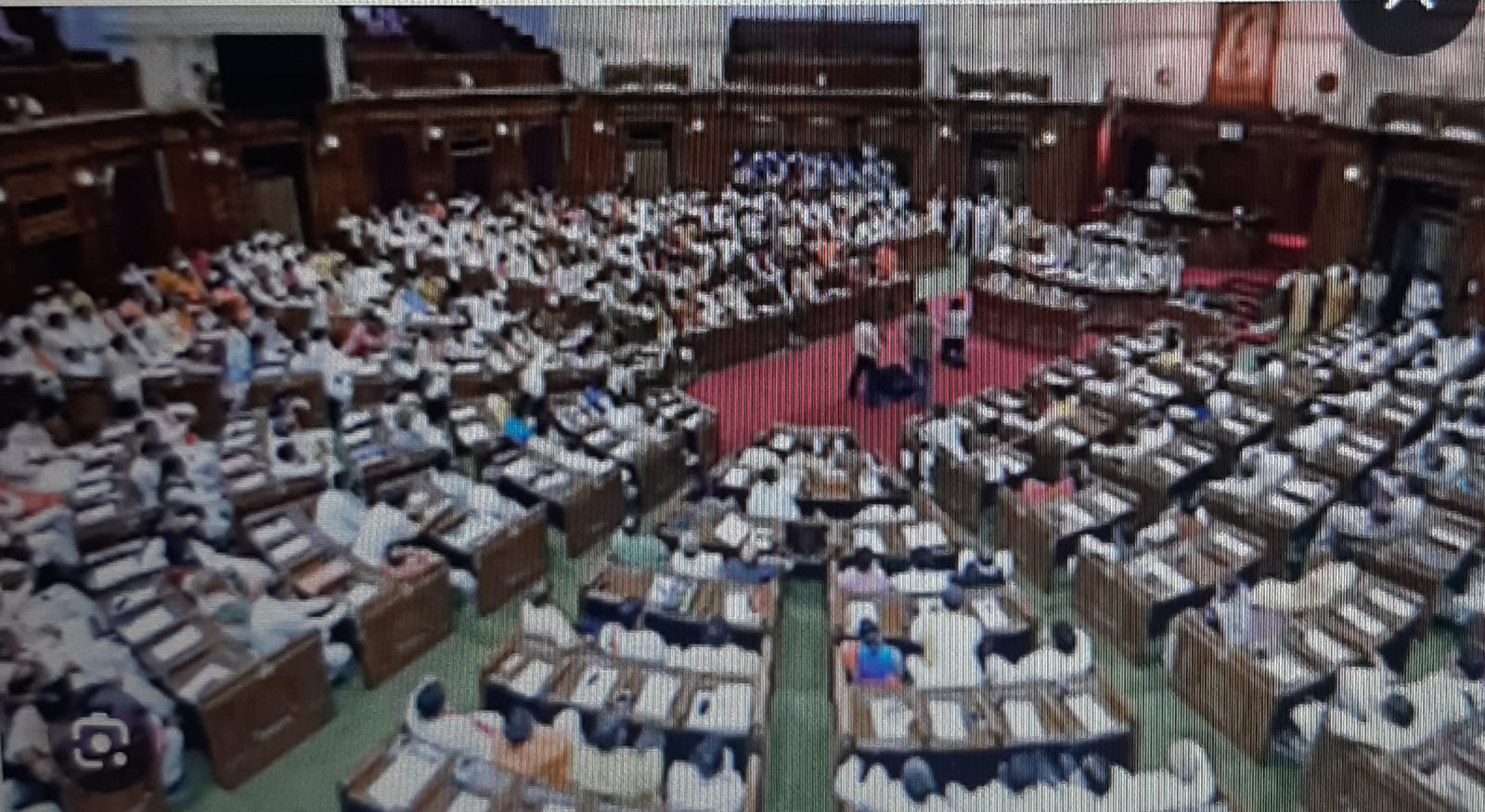
The reduced sittings of the Lok Sabha and Vidhan Sabha obviously impact legislative oversight. This is seen in the lack of debate and scrutiny of key government legislations in the legislature. The practice of introducing and passing legislations on a single day without adequate scrutiny is widely prevalent in the state legislatures. Reluctance of the government to refer key legislations to committees for scrutiny and report and the tendency to ‘bulldoze’ legislations is also undermining the control exercised by the legislature over the executive which is accountable to the Lok Sabha in the union and the Vidhan Sabha in the states.
Reduced sittings also mean less days for the question hour and reduction of opportunities for MPs and MLAs to ask questions. Be that as it may, it is seen that answers not being submitted to admitted questions is a problem that plagues other assemblies too. A perusal of data pertaining to 15th and 16th Vidhan Sabha of Uttar Pradesh shows that answers were provided to only 41.15% and 46.68% admitted questions respectively.[iv]
Table 3: 15th Legislative Assembly of Uttar Pradesh (13 May, 2007 -09 March, 2012)
| Year | No. of Questions Received | No. of Questions Admitted | No. of Questions Answered | % Questions Answered |
| 2007 | 5370 | 3764 | 1678 | 44.58 |
| 2008 | 6894 | 5340 | 1934 | 36.22 |
| 2009 | 6332 | 2552 | 1252 | 49.06 |
| 2010 | 7470 | 5736 | 2489 | 43.39 |
| 2011 | 6039 | 4997 | 1859 | 37.20 |
| Total | 32105 | 22389 | 9212 | 41.15 |
Table 4: 16th Legislative Assembly of Uttar Pradesh (08 March, 2012- continuing)
| Year | No. of Questions Received | No. of Questions Admitted | No. of Questions Answered | % Questions Answered |
| 2012 | 5260 | 4107 | 1768 | 59.03 |
| 2013 | 9080 | 4538 | 2679 | 59.03 |
| 2014 | 1730 | 1185 | 142 | 11.98 |
| Total | 16070 | 9830 | 4589 | 46.68 |
Source: Legislature and Executive: Emerging Challenges – UP Assembly
The ‘Question hour’ and the practice of certain questions being labeled ‘starred’ (where oral answers are provided by Ministers and members can ask supplementary questions) and ‘unstarred’ (where written answers are provided to members) commenced from September 1921 when the Legislative Assembly of India came into being following the Montague-Chelmsford reforms of 1919[v]. It was suspended only during war times and two of the five sessions during the emergency. Thereafter, it was suspended in 2020 during the covid pandemic on the plea that physical briefing of Ministers by officers was ‘risky’.
In a Parliamentary democracy, the executive is accountable to the legislature and Question Hour is a very important parliamentary tool for enforcing accountability. It is widely believed that asking of questions is an inherent and unfettered parliamentary right of members. It is during the Question Hour that the members can ask questions on every aspect of administration and Governmental activity and grill the Minister for his or his administration’s acts of omission and commission. Through unstarred questions, valuable information can be elicited which could later form the material for a probing starred question. If certain information is not available then the Minister or the government can give an assurance to the House and thereafter it is monitored by the Assurances Committee of the House.
The success of the system depends on the following principles: (a) all effort would be made by the government to answer the question within the stipulated time (b) no attempt to provide false information or give evasive replies would be made by the government. The Manual of Parliamentary Procedures, issued in July 2019 by the Ministry of Parliamentary Affairs, requires that replies by the government are “as precise, unambiguous and complete as possible, taking particular care to avoid expressions which are liable to be construed as evasive…. As far as possible, each part of the question should be answered separately”.
Given this tradition and well laid out procedures, if answers are not being provided by the government to admitted questions then who is to blame. Is it just the bureaucracy? Or the political executive (the Cabinet Minister) is also to blame?
Since it is the Minister, who is the face of the Ministry/department in the House, no answer to any ‘starred’ or ‘unstarred’ question can be submitted to the Lok Sabha or Vidhan Sabha secretariat without the approval of the Minister. Sometimes, the cabinet minister delegates the power to approve replies to ‘unstarred’ questions to his Minister of State. It is the primary duty of the Minister and his office to monitor submission and approval of replies to all Parliamentary or Legislative Assembly questions and pull up his Secretary if there is any delay or negligence in this regard. Likewise, it is the joint responsibility of the Minister and the Secretary to ensure the veracity of the information provided and adhere to the well laid out guidelines in the Manual of Parliamentary Procedures mentioned above.
The Minister for Parliamentary Affairs, who liaise with the Speaker and the opposition parties, are, more often than not, aware of the problem and keep raising it with their colleagues although, more informally than formally. Sometimes the Ministers are not adequately prepared and tend to be evasive. One has been witness to situations where at times, uproarious scenes have been engineered by provoking the opposition and then leaving the Speaker with no alternative other than to adjourn the House. More often than not, it is the question hour which is the first casualty.
Seen in this light, in the instant case in Karnataka where the Speaker, for once, precipitated the matter and did not heed to the pleadings of treasury benches, the shortcoming seems to be as much of the political executive as the bureaucracy. The bureaucrats take their clue from the Minister. If the Minister is ‘non-serious’ then the officers too tend to drop their guards. When senior officers see from the officer’s gallery as to how the Minister says something totally unconnected to the question which provokes the members and creates uproarious scenes leading to adjournment of the House, they first feel a sense of relief that they did not have to face a situation where the Minister could have been ‘cornered’ or forced to give an assurance. Second, they feel that they can get away with anything and then they begin to take question hour lightly.
Another disturbing trend visible in recent years is the tendency to be economical with truth. For last several decades, the unwritten convention was that no one would lie in the House. While bureaucrats would take pride in giving answers which did not reveal much, they would ensure that no ‘wrong’ or ‘false’ reply was given. In the last few years some instances have come to light (including the answer relating to drop in number of tourists visiting J&K in the aftermath of the decision to abrogate Article 370 mentioned in the article by Aniket Aga & Chitrangada Choudhury) where Ministers have given patently misleading replies to show the government in good light even when the state government and/or the department had furnished exactly what the MP had asked. Based on my experience, I can say with certain degree of certainty that, most likely, in the aforementioned case, the decision to frame the reply in the manner in which it was presented before the Lok Sabha, would have been taken by the concerned Minister (with the concurrence of other senior Ministers in the government) and not the bureaucrats as the government was determined to portray that everything was ‘normal’ in J&K. Sometimes Ministers refuse to approve the answers until they have been amended as per their instruction and senior officers acquiesce in exasperation. This is seen more at the union than the state level.
A related question that comes to mind is whether this is a problem associated with any one particular party or leader. Unfortunately, the answer is in the negative. In Karnataka, the situation would have been the same even during the previous regime. Data from UP revealed that the situation regarding unanswered questions did not really change with change in government. So all political parties would need to take a hard look at their own attitude and approach towards the legislature. They need to decide whether they want the Parliament and the legislative assembly to function as constitutional watchdogs, who rein in the excesses of the executive through judicious and effective use of parliamentary tools such as the Question Hour or just as a ‘laudatory forum’ which affixes it’s seal of approval to all proposals of the Government. In a Parliamentary democracy, the focus ought to be on negotiations between the government and the opposition, a healthy respect for opposing points of view and the need to build consensus on important issues rather than treat the opposition as political ‘untouchable’ or brand differing points of view as ‘anti-national’. In a way, what we are seeing in Karnataka or any other state legislative assembly and the parliament is a reflection of the prevailing political culture in the country.
Further, all stakeholders must realize that a system of checks and balances is essential for the success of democracy. Unbridled exercise of power by any one organ of government is a sure recipe for disaster. If the political executive displays such trends, then the permanent bureaucracy would go two steps ahead and begin to abuse power on a much larger scale with disastrous consequences for citizens. The issue would then not be limited to just not providing answer to admitted questions but also collapse of the committee system, reduced sittings of the House and even extend to non-compliance with judicial pronouncements in civil, criminal and even constitutional matters. The way the judiciary is struggling to get the executive to adhere to the guidelines laid down by the Supreme Court regarding use of bulldozers by the state to demolish properties of accused is a pointer to the strain in the relationship between the three arms of government.
It is also distressing to note that, at times, action of constitutional authorities like the Speaker and the Chairman seem to indicate that party affiliation means more to them than upholding the Constitution. Instances of false information and/or suppression of facts by the government have come to light but no action has reportedly been taken even where breach of privilege is involved. The tendency of presiding officers to turn a blind eye or overlook the parliamentary transgressions of the ruling party/coalition is seriously eroding the credibility and legitimacy of the legislature itself. The responsibility of running the House is of the Government and the Speaker has to safeguard the rights of all members and not just the ruling party.
In order to ensure that the Parliament/Assembly sessions are not curtailed and they meet for a sufficiently long time to ensure accountability of government towards the legislature, it has been suggested that the power to decide the commencement and end of Parliament/Assembly sessions could be taken away from the executive and given to the legislature. Likewise, the dates of Budget, Monsoon and Winter sessions could be fixed as is the case in United Kingdom, Canada and Australia. In India, the date of presentation of union budget has been fixed. Suggestions to have a minimum of 100 sittings for Parliament and 90 days for legislatures in larger states and 50 days in smaller states have also been made. These could perhaps be incorporated in the Constitution itself.
The efficacy of parliamentary tools and practices must be constantly analysed. If there is a trend that just 13 percent of the MPs ask 80 percent of the questions[vi], then that is not a good sign. Likewise, a system could be devised for providing answers to sensitive issues dealing with national security or commercial interests so that the system is not abused by certain sections for furthering their partisan ends.
Finally, all parties must agree that disruption of the proceedings of the House is not good for ensuring accountability of the executive towards the legislature. It lets the executive walk away gleefully even if some political brownie points may be scored. In a mature democracy, disruption of legislative proceedings must be a ‘rare’ and not ‘routine’ phenomena.
To conclude, the Karnataka episode is a snapshot of the downslide in the functioning of the legislature in India. It is not just a question of bureaucratic apathy in answering questions but is also a pointer to the increasingly dysfunctional nature of the system of checks and balances between the executive and the legislature. While strict action must be taken against those officers who are found to be deliberately lethargic and negligent in answering questions, it is also time to rein in the political executive and fix responsibility of cabinet ministers. The downslide in the functioning of the legislature is not a good omen for the future of parliamentary democracy in the country.
(Sunil Kumar is a visiting Senior Fellow associated with the Centre for Cooperative Federalism and Multilevel Governance in Pune International Centre and a former civil servant. Views expressed are personal.)
[i] Miffed over Karnataka government’s failure to provide answers to questions, Speaker abruptly adjourns Assembly; The Hindu, March 16,2026; https://www.thehindu.com/news/national/karnataka/miffed-over-karnataka-governments-failure-to-provide-answers-to-questions-speaker-abruptly-adjourns-assembly/article70749626.ece
[ii] Siddaramaiah pulls up cabinet ministers for delays in furnishing replies to legislators’ questions; The Daily Hunt, March 18,2026;https://m.dailyhunt.in/news/india/english/south+first-epaper-southfst/siddaramaiah+pulls+up+cabinet+ministers+for+delays+in+furnishing+replies+to+legislators+questions-newsid-n704888855
[iii] Why Decline in the Sittings of Parliament and Assemblies is Worrying?; Abhijit Banare, The Quint, December 23, 2018; https://prsindia.org/articles-by-prs-team/why-decline-in-sittings-of-the-parliament-assemblies-is-worrying#:~:text=Why%20Are%20Sittings%20of%20An,are%20passed%20without%20much%20discussion.&text=Similarly%2C%20the%20legislature%20is%20also,state%20legislatures%20or%20remain%20inactive.
[iv] Legislature and Executive: Emerging Challenges; https://uplegisassembly.gov.in/principalsecretary/pdf/Legislature_Executive_Emerging_Challenges.pdf
[v] Parliament’s Question Hour Was Subverted Before Suspension; Aniket Aga & Chitrangada Choudhury; Monday, 14 Sept 2020; https://www.article-14.com/post/parliament-s-question-hour-was-subverted-before-suspension
[vi] Is Parliament’s questions system broken? — Here’s how to fix it!; Shivam Sankar Singh, March 13, 2016; https://shivsamshankars.medium.com/how-to-get-a-question-selected-in-the-indian-parliament-rigged-system-or-just-a-flawed-one-8e9de683e126