

It is time that the politics behind the move to appoint outgoing Sarpanch / Pradhans as Administrators and all ERs as members of the Administrative Committee is understood by all stakeholders. The bureaucracy should understand that appointment of Administrators goes against the spirit of the Constitution and can only be justified, at best, in times of national emergency and/or pandemic. The State Election Commissioners must understand that they need to pro-actively work to ensure that elections are held in time and in a free and fair manner. As constitutional authorities they cannot be seen to be dancing to the tune of State Governments, writes Sunil Kumar, a former civil servant.
So far, local government elections used to get delayed. It did not matter whether these were rural or urban local governments. But now a new trend is being seen viz. to appoint the Sarpanch/ Pradhan as the administrator after their term is legally over. We have seen this in Uttarakhand, Rajasthan, Maharashtra and now in Uttar Pradesh. The bug seems to be spreading fast in the BJP -ruled states. It may not be long before states ruled by other parties too catch on. This is the new BJP model of grass-root democracy at play.
Panchayat elections have a long tradition of being delayed in most States. The State Panchayati Raj Acts and Rules provide for appointment of Administrators, if due to unavoidable reasons, elections cannot be held in time. In most states, the tradition had been that the Additional Development Officer (ADO) looking after the Panchayats in the Block would be appointed the Administrator of all Gram Panchayats. For the Block Panchayat, it would be the Sub-Divisional Officer (SDO) and for the District Panchayat, the District Collector. In some states, there is a provision for appointment of Administrative Committee too.
Article 243E (1) in Part IX of the Constitution stipulates that ‘every Panchayat, unless sooner dissolved under any law for the time being in force, shall continue for five years from the date appointed for its first meeting and no longer’. Sub clause (3) (a) of the same article clearly specifies that election to constitute a Panchayat shall be completed before the expiry of the term specified in clause (1). In case it is dissolved, elections are to be held before the expiry of six months from the date of the dissolution as per Article 243E (3)(b). It can be inferred that there could be situations where the Panchayat has been dissolved and, since there cannot be an administrative vacuum, administrators could be appointed as a ‘stop-gap’ arrangement. However, the Constitution does not envisage a situation where local government elections are not held before the expiry of the term. There is no provision of rule by administrators in the Indian Constitution after the expiry of the term of the Panchayats.
Since the State Panchayati Raj (PR) Acts and Rules were in existence prior to the enactment of the 73rd Constitution Amendment Act (CAA), necessary amendments were carried out in those Acts by the state governments in the aftermath of the coming into force of the 73rd CAA, to bring them in conformity with the constitutional provisions. It seems that this particular clause in the State Panchayati Raj Acts and Rules escaped the attention of the lawmakers. The provision for rule by Administrators for a period of six months in case of non-constitution of a duly elected Panchayat owing to unavoidable reasons continues to exist in the State PR Acts. This provision has not been objected to by the Union government or any political party or the State Election Commissioner who is constitutionally charged with the duty of organizing the Panchayat elections (Article 243K (1). The said provisions have, so far, not been struck down as ultra vires by any High Court or the Supreme Court despite numerous cases having been filed over the years. The Courts have drawn the attention of the state governments and the State Election Commission (SEC) that they are duty-bound to hold elections before the expiry of the five-year term of the Panchayats. They have even fixed timelines for holding elections and, in some case, even threatened the State Election Commissioner with ‘contempt of court’ if elections are further delayed. But they have stopped short of determining the legal validity of the ‘rule by Administrators’ after the expiry of the term of the Panchayats reflecting the delicate balancing act the Courts need to play at times.
Consequently, State Governments seem to have perfected the art of delaying holding of elections if it did not suit the ruling dispensation in the States ‘politically’. Elections are delayed on various grounds, the common ones being delay in undertaking reorganization of Panchayats and delimitation of boundaries; non-finalization of reservation of seats by the State Government; delay in publication of final electoral rolls by the SEC etc. Reasons for delay in holding elections have been examined in detail in a separate paper.[i] In this paper, the politics behind appointment of Administrators is being examined.
Before we examine the implications of this new trend, let us understand the facts of the case. In Uttarakhand the term of the Gram Panchayats was to end in November 2024. The State government was not keen on holding the elections in time. The SEC also did nothing to ensure elections were held on time. Consequently, the State Government first, vide notification dated 26th November, 2024, appointed the concerned ADO (Panchayat) as the Administrator of all GPs in their Block. SDO and District Collector were also appointed administrators of Block Panchayats and District Panchayat respectively. However, yielding to political pressure exerted by the outgoing elected representatives, the State Government, vide notification dated 12th December 2024, amended its earlier order and appointed the outgoing Pradhans and Presidents of Block and District Panchayats as Administrators in place of administrative officers. This was the beginning of a new trend in BJP-ruled States.
In Rajasthan, the State government used this precedent to appoint outgoing Sarpanches as Administrators of 11,300 GPs in November 2025. However, it appointed officials as Administrators of Block and District Panchayats. In February 2026, Government of Maharashtra appointed outgoing Sarpanches as Administrators and Deputy Sarpanches and all ward members as members of an Administrative Committee in about 14,312 GPs. In May 2026, Uttar Pradesh has followed suit and appointed 57,964 outgoing Pradhans as Administrators of their GPs.
However, while Himachal Pradesh, a Congress-ruled State, too did not hold elections in time (and had to hold elections in May 2026 under orders of the High Court), it did not appoint outgoing Sarpanches / Presidents of Block and District Panchayat as Administrators. Instead it notified Administrative Committees headed by the BDO as Chairperson and Panchayat Secretary as Member Secretary for GPs; Chief Executive Officer (CEO)as Chairperson, Social Education & Block Planning Officer as member and the Panchayat Inspector/Sub Inspector as Member Secretary for Panchayat Samitis (Block Panchayats) and the CEO as Chairperson, District Development Officer (DDO) as member and District Panchayat Officer as Member Secretary for District Panchayats. In Karnataka, another state being governed by the Congress, Panchayat elections have been delayed on account of delay in completing the boundary delimitation and reservation exercise. Elections are likely to be held by December 2026. However, the State government has not issued any statewide order regarding appointment of Administrators in Panchayats. It seems to have been left to the discretion of the Deputy Commissioners to appoint suitable officials as Administrators for GPs. The factual position has been summarized in Table 1.
Table 1: Status of Appointment of Administrators in different States
| State | Election
Due |
No. of GPs with Sarpanch / Pradhan as Administrators | Whether Case filed in High Court | Decision of High Court | Current Status |
| Uttarakhand | November 2024 | 7,795 | Yes | SEC & State Govt. forced to hold elections before 31 July, 2025 | Elections held in July 2025 |
| Rajasthan | September -November 2025 | 11,300 | Yes | SEC & State Govt. directed to hold elections by end of July 2026 | Elections to be held before July 2026 as per H.C. Order dated 22.5.2026 |
| Maharashtra | December 2025 – January, 2026 | 14,312 | Yes | Case pending in Bombay High Court | Elections not announced by the SEC. Matter sub-judice. |
| Uttar Pradesh | May 2026 | 57,694 | Yes | Case pending in Allahabad High Court | Elections not announced by the SEC. Matter sub-judice. |
| Himachal Pradesh | January 2026 | 0 | Yes | H.C. directed elections to be held at the earliest | Committee headed by officials was appointed as Administrators for 3,577 GPs. Elections held in May 2026 |
| Karnataka | December
2025 – January 2026 |
0 | Yes | SEC has filed petition in H.C. against the delay in holding elections. Case pending in H.C. | Matter is sub-judice. DCs have appointed officials as Administrators in 5,950 GPs. Elections likely to be held by December 2026 |
Although the Constitution specifically ordains that the election process must be completed before the expiry of the five-year term, the State Panchayati Raj Acts do have provision for appointment of Administrators to look after the affairs of the Panchayats in case they are dissolved before the expiry of their term or if elections cannot be held on schedule due to ‘unavoidable’ reasons. However, we are increasingly seeing that none of the reasons cited by the State Governments and/or the SEC are able to withstand judicial scrutiny in Courts. This does not prevent the State Government from playing politics and taking recourse to provisions in the State PR Acts to delay elections and appoint Administrators.
However, it would be pertinent to note that Local Government elections were held on schedule (November-December 2025) in Kerala despite the looming State Assembly elections in April-May 2026. Earlier, Panchayat elections had been held in April-May 2021 on schedule even in Uttar Pradesh when the second wave of Covid pandemic was at its peak. (Over one thousand polling personnel lost their lives in the process.) This decision of the UP Government had then been universally lauded as upholding democratic standards. Seen in this context, the recent decision of the same Yogi government in Uttar Pradesh to postpone Panchayat elections and go to the extent of appointing outgoing Pradhans as Administrators is undemocratic to say the least.
Why is this new trend of appointing outgoing Elected Representatives (ER) as Administrators particularly disturbing? Votaries may argue that after all, instead of a bureaucrat, it is the outgoing elected Sarpanch/Pradhan who is being appointed as the Administrator. The Administrator is authorised to look after only routine functions and not take policy decisions or start new projects. So what is wrong in this?
There is no legal provision for extension of tenure of ERs in the State PR Acts. After the expiry of the term, the Panchayat has to be dissolved. Thus, the outgoing Sarpanch/Pradhan is reduced to the status of an ordinary citizen / voter. Thereafter, how and why the State Government has selected him/her for officiating as an Administrator for a period of six months or till such time as the new Panchayat is constituted is left unexplained. There seems to be no legal justification for this action by the State Governments. The matter is currently sub judice in the Bombay High Court although the Aurangabad Bench of Bombay High Court has, in its order dated 26th March, 2026[ii], cast serious doubts on the validity of the Government Resolution dated 20th February issued by Govt. of Maharashtra.
There are some judicial pronouncements of Constitutional Courts which have clearly held that appointment of outgoing Sarpanch/Pradhan as Administrator is illegal and without jurisdiction.[iii] Likewise, the Supreme Court also held in Kishansing Tomar vs Municipal Corporation of the city of Ahmedabad case in 2006 that Article 243U was inserted in the Constitution ‘to avoid the mischief of delaying the process of election and allowing the nominated bodies to continue..’ What has been done in Maharashtra (where all outgoing ERs have been accommodated as Administrators and/or in the Administrative Committee to look after routine administrative matters) amounts to de facto extension of the tenure of the Gram Panchayat. This is virtually the subversion of democracy itself.
It is clear that State Governments are well aware of the constitutional and legal provisions. Yet they delay elections and try to derive ‘political mileage’ as they know that the judicial process would take time and that could give them the time to carry out their designs. For instance, the Rajasthan government used the time to carve out 3,484 new GPs and thereby increase the number of GPs by almost 30 percent. Uttar Pradesh government perhaps fears that any adverse verdict in the Panchayat elections could affect their prospects of retaining power in the 2027 State Assembly elections. By appointing Pradhans as Administrators, the State Governments hope to garner their political support in the larger battle.
The complicity of the SECs with the state governments is also clearly evident. None of the SECs (except Karnataka) approached the High Court or the Supreme Court with the prayer to issue writ of mandamus to the State Government to provide all necessary assistance to enable them to hold the Panchayat elections in time and in a free and fair manner despite SC judgment to that effect[iv]. In Uttar Pradesh, the SEC has postponed four times the process of finalization of electoral rolls on one pretext or the other even when the exercise had been initiated well in time (November 2025) and could have been completed in January -February, 2026. The State government set up the five-member Dedicated Backward Class Commission for determining OBC reservation in Panchayat elections only on 18 May 2026. The commission is expected to carry out the “triple test” exercise mandated by the Supreme Court before granting OBC reservation in local body elections and submit its report by November 2026. Thus, it is almost certain that, unless there is judicial intervention, Panchayat elections are unlikely to be held before December 2026 and, then it could get further postponed owing to the forthcoming Assembly elections in March – April 2027. In Maharashtra, the SEC has not yet announced the election schedule although the six month time-limit committed by the State Government in the High Court would expire in June 2026. The plea taken could be that the matter is sub-judice in the Bombay High Court as now the question of clubbing all matters filed in Aurangabad and Nagpur benches and the circuit bench at Kolhapur with the matter at the Principal Seat is pending before the Hon’ble Chief Justice on the administrative side.
The Karnataka SEC alone has filed a petition in the High Court stating that delay in completion of delimitation and reservation exercise would pave the way for appointment of Administrators in the GPs which would be against the Constitutional mandate. The matter is reportedly still pending before the High Court.
It seems that the BJP-ruled states seem to believe that by appointing the Sarpanch / Pradhan as Administrators after the expiry of their term (and all ERs on the Administrative Committee as in Maharashtra) they are furthering democratic ideals. However, since these persons ceased to be ERs after expiry of their term, their status is that of a functionary appointed by the Government. Hence, legally this cannot be construed as strengthening democracy or furthering accountability and transparency. It seems to be a step towards the goal of having bureaucratic arrangements like the one in industrial development authority areas (NOIDA) in place of democratically elected local governments. This could be the proverbial ‘testing of waters’ by the State Governments in BJP-ruled states. If there is no opposition and push-back from the people and the Courts, the model could be given a formal shape under the pretext of introducing ‘One Nation, One Election’ system in the country.
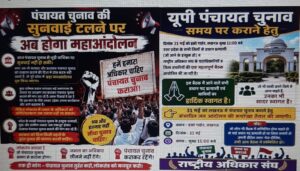
While the legality of the new trend of appointing Sarpanch / Pradhans as Administrators would be decided by the Courts in due course, a heartening development seems to lie in the public reaction it has evoked in states like Maharashtra and Uttar Pradesh. In both states, the issue has been challenged in Courts by voters and aspiring contestants alike. In Uttar Pradesh a forum called ‘Rasthriya Adhikar Sangh’ has been formed which is spearheading the demand to hold Panchayat elections without further delay. A large number of possible contestants in the Panchayat elections are extensively using the social media to run a campaign on this issue. This is happening perhaps for the first time in recent memory where public pressure is being exerted on the SEC and the State Government to hold Panchayat elections on time. This is illustrative of deepening of democracy at the grassroots.
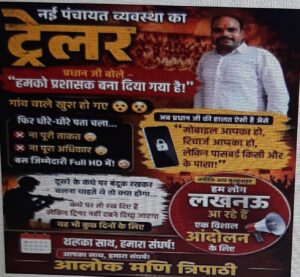
It also seems that not all outgoing Sarpanches/Pradhans are happy with being appointed Administrators. They feel that the responsibility of providing all basic services has been thrust on them wherein they can only do routine works and are at best ‘lame duck’ incumbents. Before elections, they may receive all the brickbats if they are unable to deliver as the voter may not understand that they do not have ‘full powers’.It seems then that the Government’s efforts to win over the Pradhans and build a loyal constituency of supporters in the ensuing Assembly elections in Uttar Pradesh may backfire.
Thus, it is time that the politics behind the move to appoint outgoing Sarpanch / Pradhans as Administrators and all ERs as members of the Administrative Committee is understood by all stakeholders. The bureaucracy should understand that appointment of Administrators goes against the spirit of the Constitution and can only be justified, at best, in times of national emergency and/or pandemic. Non-completion of delimitation or reservation exercise cannot become a ground for delaying elections and paving the way for appointment of Administrators. The State Election Commissioners must understand that they need to pro-actively work to ensure that elections are held in time and in a free and fair manner. As constitutional authorities they cannot be seen to be dancing to the tune of State Governments. Political parties should recognize that silence on this issue weakens democracy. The judiciary must realize that delay in deciding related cases (so as to render them infructuous) only exposes their failing as custodians of the Constitution and constitutional values. Above all, citizens must realize that if their right to vote is taken away at local government level and constitutional institutions like the Gram Sabha are made infructuous, then any hope of ensuring accountability of elected representatives in State Assemblies and the Lok Sabha would also fade away, slowly but surely.
(Sunil Kumar is a visiting Senior Fellow associated with the Centre for Cooperative Federalism and Multilevel Governance in Pune International Centre and a former civil servant. Views expressed are personal.)
[i] Addressing Election Delays in Local Governments by Sunil Kumar; The India Forum; 14.07.2025; https://www.theindiaforum.in/politics/addressing-election-delays-local-governments
[ii] Kantabai Sudhir Mule vs The State Of Maharashtra And Others on 26 March, 2026; https://indiankanoon.org/doc/78461983/
[iii] Krishna Kumar versus State of Uttar Pradesh; Allahabad High Court, Lucknow Bench judgment, 2010
[iv] Case No.: Appeal (civil) 5756 of 2005; Kishansing Tomar vs Municipal Corporation of the City of Ahmedabad; SC, 19th Oct.2006;